Sunday, 16 November 2008

Chedi-Chedi, Prang-Prang

Navigating ancient Ayutthaya, the Venice of the East

Si Sanphet Wonderland
Wat Si Sanphet

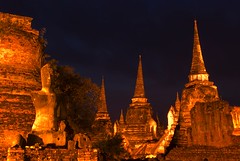
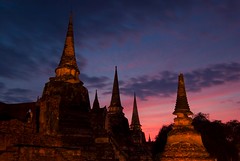
The diminutive Thai security guard approached me out of the gathering gloom of dusk, the spotlight casting his giant shadow against the illuminated chedi. We close now he politely said, beckoning me towards the exit. It was sadly time to drag myself away from the magical temple courtyard of Buddha statues, broken columns, white-flowering trees, bell-shaped chedis and towering prangs all brightly lit in yellows, oranges and greens. I had just taken my last photograph of the row of three graceful chedis of Phra Si Sanphet, each topped with spires of ever-diminishing discs, that glowed against the now-black sky. The tour parties had long departed; leaving me to watch the sunset paint the sky red behind the technicolour temples in tranquil solitude. I reluctantly headed for the exit, taking one last glance over my shoulder at the multicoloured wonderland before cycling back to my hotel through the historical parkland.
Si Sanphet Sunset
Wat Si Sanphet Sunset

Ayutthaya was founded 700 years ago on an island formed by the confluence of three fast-flowing rivers as the second great royal capital of Siam. Completely encircled by the rivers and criss-crossed with canals, it was aptly dubbed the Venice of the East by the first European explorers to set their eyes on the city in the 1500s. The city was a metropolis capital, religious centre and trading port. Ships regularly visited its riverside wharves from Europe, Indonesia, Malaysia, Japan, India, Persia, Arabia and China while Siamese ships sailed in the opposite directions across the Indian Ocean and South China Sea. The great Chinese naval captain Zheng visited Ayutthaya in 1407 and made a benefaction to the nearest temple to the portside warehouses. Foreign trading communities lived in specially designated residential quarters where they were allowed to govern themselves and follow their own religions. Ayutthaya flourished for 400 years until sacked by the Burmese army in 1767.
Phra Ram Lotus Pond
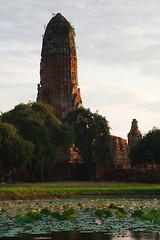
Wat Phra Ram with lotus flowers

The Buddhist Kings of Siam built monumentally beautiful temples, known as wats, to honour their departed fathers. The Burmese destroyed much, decapitating most of the Buddha statues, but the main temple structures survived the flames and hammers. Most of the temples and palaces that remain today are preserved in an historical park of fragrant trees, lotus-filled canals and white-painted bridges that occupies much of the western half of the island. Modern Ayutthaya takes up the remaining half, its streets following the same grid pattern followed by the canals. The city lies on the flat floodplain about an hour and a half drive north of Bangkok.
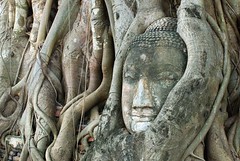
Matathat Buddha Head
Buddha head at Wat Matathat

The very centre of the Siamese Kingdom was found under the prang of Wat Matathat, a type of temple that lay at the heart of every major Siamese city and under which lay buried a relic of Buddha. Following archaeological excavations in 1956, the relic has been on display in one of the city museums. Matathat is notable for a fallen Buddha head that has been taken up by the twisted roots of a banyan, a Buddhist holy tree. This growing together of nature and art is seen as very auspicious by Thais and it is sometimes decorated with cloth and offerings to request merit from the Buddha.
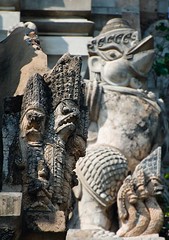
Nagas and Garuda on Ratchabaruna
Nagas and Garuda of Wat Rathchaburana

Next door to Matathat is Wat Ratchaburana which has the best surviving prang in Ayutthaya rising above the trees. Each temple is laid out as a square and aligned on the compass points. The prang is in the very centre and represents Mount Meru, the holy mountain of the Buddhist heaven. Chedis surround the prang, each representing a cosmic plane. Chedis at the four corners stand for the four human universes of physical being. Ratchaburana’s prang still preserves the stucco relief statues of garudas, nagas and other mythical beasts. Robbers unfortunately dug below the prang and made off with a treasure of royal gold but thankfully two of them were caught and some of the gold objects saved.
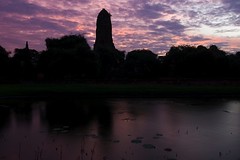
Phra Ram Sunrise
Wat Phra Ram sunrise

Across the park, the prang of Wat Phra Ram is reflected in the surrounding canals, and best seen at sunrise or sunset. Next to it is Wat Phra Si Sanphet with its line of three chedis. This was the temple of the Siamese royal family and the adjacent remains of the extensive palace lie in manicured lawns.
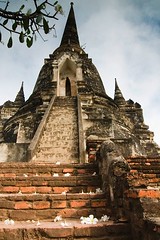
Flowers for a King
Flowers for a King

These four wats comprise the core of ancient Ayutthaya and are easily visited on foot or by bicycle through the historical park. They all become magical lanterns towering into the night sky when the spotlights are turned on at sunset.
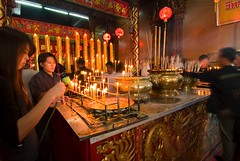
Phanan Choeng
Wat Phanan Choeng

Other ruined chedis and walls pop up on the roadside throughout the modern city. Further away and off the island are three major riverside temples. Wat Phanan Choeng, the temple associated with Zheng He, is to the east of the island. Very much an active working temple, it is bustling with devotees praying in the halls decorated with Chinese script and dragons.
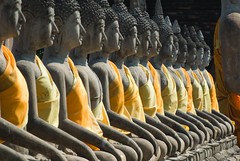
Yai Chai Buddhas
Wat Yai Buddhas doing here?

It is a short distance to the delightful garden temple of Wat Yai Chai Mongkhon, which is again busy with devotees. Hundreds of Buddha status, each draped on orange sashes, line the four walls of the central courtyard and gaze down impassively in front of the central chedi. Climb up into the chedi and you find seven Buddhas covered in gold leaf and set in niches. Thais come to speak merit requests into small pieces of paper, wipe them on the Buddhas then cast them in to baskets. Gardens of flowering trees and shrubs extend outside the courtyard and make a suitable environment for a giant sculpture of a reclining Buddha to enjoy dappled shade.
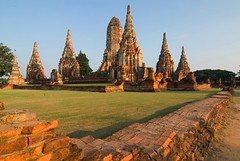
Chai Wattarama Dusk
Wat Chai Wattanaram

To the west of the island is Wat Chai Wattanaram, which has more chedis surviving around the central prang than any other temple. Visit in the late afternoon to enjoy the breathtaking sunset then stay to watch it also come alight after dark. Two rarely-visited temples to the west of the island contain an ornate Ayutthaya-style Buddha-as-King statue and the only Burmese temple architecture in the city. These off-island temples can be visited by the more adventurous on bicycle, and Thai drivers tend to be relatively considerate, or by Sawngthaew, the small three-wheeled open-sided taxis that buzz around the roads.
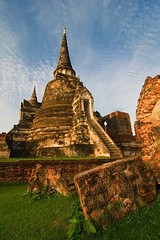
Chedi
One Chedi of three at Wat Si Sanphet

You can visit all the temples independently, which are open from 7.30am to 6.30pm for an entry fee of 20 to 30 baht at each, or join one of the many tours that take you around all of the main wats in one day or the five illuminated wats at night. Most people spend one hot day or an overnight afternoon/morning visiting the temples. But, if you have more time, slow down to take in only two or three temples a day, wander through the historical park and make sure you visit the Historical Study Centre and the Museum to see the gold objects and Buddha relic excavated from below the prangs of Wats Matathat and Ratchaburana.
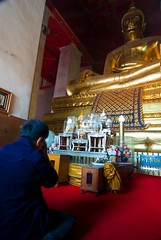
Devotee
Golden Buddha

The temples are best seen in early morning and late afternoon when the wats take on an orange hue and their architecture is picked out by the shadows of the low sun. Make sure you stay later at Chai Wattarama or Si Sanphet to savour the vibrant colours when sunset mixes with the illuminated wats. That is the time when the colourful magic visits and you won’t want to return to the black and white world outside.
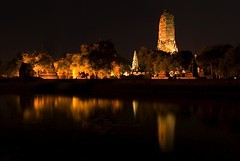
Phra Ram Reflections
Reflections on a Wat

All’s fair..

We’re in the ancient capital of Ayutthaya. The ancient city is spread throughout the modern town and a stroll in the park has me threading among prangs, chedis and wats. Wat Phong never fails to make me giggle – British toilet humour as refined by years of Carry On culture.

Our days have settled quickly into satisfying routines, with Bill photographing for all he’s worth and me mainly sat on the guest house balcony editing a book on the human genome and taking dips in the pool every now and again.

The Sherwood Guest House is a great find, friendly staff, decent pool, near the main focus of the archaeology and, apparently, usually quite quiet. HOWEVER... 12 November sees Loi Krathong , where Thais flock to the waterways to Loi their Krathongs (send their lights) on the water. We expect merit making (in Bangkok this usually takes the form of dumping sacks, and I mean SACKS, of sliced bread in the waters for fishes to spume over). I think there’s also a tradition of buying caged birds or bagged live fish to release them. We expect candles in the sky and on the lotus-choked waters, perhaps even outdoing the Blackpoolesque illuminations of the main streets.

In association with Loi Krathong the fair is in town – food, food and more food, drinks, darts at balloons to win fluffy Manchester United pillows, stalls full of shades, shoes and tat, piles of wooden furniture including garden pagodas you’d need planning permission for in the UK, kitchen units galore and a glorious plant market bright with orchids, fragrant with jasmine.

Perhaps the most notable feature is the outdoor cinema – we know the thing now, for most countries except UK it seems. And the thing is this: It is NEVER loud enough until it distorts.

Last night a crocodile was eating one half of a student, while his friends tugged at the other – we didn’t sit it all out, but my guess is the crocodile won.

Thursday, 13 November 2008

Poolside in Ayutthaya


Poolside in Ayutthaya
Originally uploaded by Bill Bevan
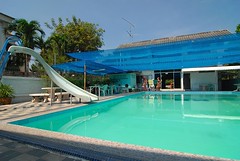
What better place to stay when in hot Ayutthaya then a guesthouse with a pool? It is unusual to say the least to find a backpacker-priced guesthouse with a pool.

We found a couple in big, old colonial courtyard houses in Nicaragua but they were both owned by the same people who had installed what amounted to little more than puddles as part of the backpacker luxury package. Very welcome they were too.

The Ayutthaya pool is much bigger, maybe 10 metres in length, and a one-off in town. It is part of the Sherwood Inn, on one of the roads close to the Ayutthaya ancient ruins. Its very presence epitomises the attitude of the guesthouse manager of providing good, friendly service at a budget price. A double room wil set you back just 280 baht, or 5.50 GB pounds before the exchange rate worsens due to the sinking pound.

Not only is there a pool that is long enough to swim lengths, pleasantly short lengths that is, but there is also plenty of space for yoga, reading and enjoying meals from the great kitchenv Add in a poolside balcony, that has almost become Georgia's private workspace as she completes an editorial contract, and the presence of only five rooms and the Sherwood makes for a very relaxing base to explore the ruins.

Friday, 7 November 2008

Buddha on a Mountain

http://www.flickr.com/photos/billbevan/sets/72157608730241568/

While Georgia went to a local hotel pool, I headed off down the still-quiet streets at 7am to visit the Golden Mount, a temple built on top of a large artificial mound founded on a raft comprising thousands of logs. Strangely surrounded by a market and fair ground, including shooting games, the temple mount is an oasis of calm above the noisy city. A spiralling path winds around the outside of the mount to a temple topped with a red draped golden stupa. Early-rising Thais were already praying and offering flowers and incense to the golden Buddhas inside. Others were making more unusual offerings at the stupa. Marker pens were laid out amongst the flowers and incense for people to write messages on the red cloth cloaking the base of the stupa. Most people would write a message, most likely a wish, take a small orange pillow with a folded cut-out cardboard flower, kneel to offer it to the stupa then circle the stupa three or four times. After they finished, they would pin a 20 baht note onto a criss-cross of washing line suspended above head height.

Lady Boys and Tofu...

...never let you down.


http://www.flickr.com/photos/billbevan/sets/72157608730241568/

It is great to be back in Bangkok again. The city reaches out with an instant warm welcome unsurpassed by any other major capital we have yet been to. It starts at the airport with the gentle smiles and easily given directions from courteous staff and continues on the quite airport express bus into the city centre that cruises along empty four-lane highways - at least until it meets the clogged arteries of dowtown. The easy welcome carries on in the reception desks of the backpacker hotels as you are handed keys to check out the rooms, but most of all the pleasant feeling of arrival is everywhere on the streets. This is due to two major cultural Thai traits. Thais don't rush and they eat on the streets. Every Thanon and Soi is lined with eateries, offering cheap stir-fries, fresh chilled fruit that varies from the recognisable pineapple and melon to the more Asian exotica that is the aptly named Dragon Fruit and the pungent Durian.

In our first two days here we have done some of our favourite activities in Bangkok. After checking in to the cheap but very clean Bella Bella Guesthouse in Banlampu, the first thing we did was to grab some fresh stir-fried food from a street vendor. We found a stall specialising in vegetarian food, so we didn’t have to hover over the dried shrimps and say no repeatedly until we had received the food without their liberal application, while enjoying fantastically cooked and delicious tofu with garlic, fried vegetables with tofu and spicy salad with tofu. Next door was a smoothie bar run by two lady boys. All around were pot plants on the street. We then took a ferry down the river to get a cool breeze and away from the traffic noise and followed that with a Thai massage in a tranquil garden. Georgia then called into a 7-11 for an ice lolly. That finished the evening, and a stretch of 32 hours flying without sleep, perfectly. We were in bed after 9pm, jetlag beating.

The next day, Friday 7th, we visited the Royal Barges Museum, a floating delight of sparkling gold leaf, coloured glass and ornate wood carving. There are four graceful boats still kept to in immaculate condition to carry the royal family along the river for major ceremonies. The bowhead of each is carved into a mythical being that carried one of Brahma or Vishnu in Indian epics, including a multi-headed serpent-like Naga, a garuda and a bird. The walk to the museum was along narrow alleys between houses given a glimpse of how Bangkok may have been 50 years ago before the rise of concrete and futuristic skyscrapers. We went on the river again then had a failed evening of shopping and drinking, the mall had closed by the time we got there, the skybar enforced a no sandle dress code. We made up for it with a beer under a tree back on the street of or guest house.

Stottie Welcome to Newcastle


P_DSC_6805_1
Originally uploaded by Bill Bevan
Which other airport boasts a Greggs the Bakers next to the Check-In desks? Every airport should have one so that pasties, buns and stotties are available the minute you land or for a last taste of Britain before flying. I was tempted to take a stottie to show off our ethnic cultural food to Thais but the added weight would have put my bags over the weight allowance. They will have to wait another time. Even better were the normal highstreet prices, infact a cheese and onion pastie here was 10p cheaper than Sheffield city centre. Tea was good but the coffee was reportedly washing-up water standard.

Friday, 3 October 2008

From Buccanear to F'Kinnear

When Joe Kinnear held his first bleeping press conference as manager of Newcastle United. 

The first press conference perfomance by Newcastle United's latest new manager takes me back to the mid-1990s. King Kevin Keegan ruled supreme and Newcastle had such a attack-minded swashbuckling style that they became styled the Entertainers and everyone's second favourite team. Keegan put all in his buccaneering football philosophy and eventually missed out on the Premiership title by a handful of points. Joe Kinnear's surprise appointment to replace Keegan after the Messiah's second coming came to an abrupt end attracted plenty of press amazement. Joe has quickly demonstrated his attacking credentials too. This time it was the assembled journalists who were on the defensive rather than a flat-footed back four as Joe launched into a tirade of F and C words.

The ensuing media attention has made most of how many words have to be bleeped before any of his conference could be broadcast. There is an old adage I have now stopped using when thinking about Newcastle. The one that goes 'it can't get any worse.' Newcastle's stock has plunged quicker than the Dow Jones and instead of the Bank of America coming to the rescue we have someone from Nigeria who, I'm all too sure, has promised to buy the club by email in return for Ashley's bank account details. I would not put it past our lager-swilling mate of the terraces to fall for the scam after being careless enough not to check out the mortgage repayment conditions on St James's Park. How can people become so rich while being so careless?

So what next in the comedy revue that currently is Newcastle United Football Club? I shudder to think what might be round the next corner, who will be behind the next own goal and when they will be next put on the spot. 


Thursday, 11 September 2008

Will You Buckle?

Will Buckley performs as the Man Who Wants to be Read in front of an audience of journalism hopefuls at Hepstontall, West Yorkshire. Meanwhile England are beating Croatia 4-1.

Will Buckley sits, slouches and slides around in the faded armchair for an Audience with… in front of a semi-circle of 16 budding journalists. Buckley’s adrenalin-fuelled performance as the self-styled wine swigging, bar-propping journalist coincidentally coincides with England’s resounding victory against Croatia in their World Cup qualifier. It is somewhat ironic that while the Observer’s Senior Sports Writer is given a talk chaired by the Sunday Mirror’s Senior Sports Writer, England are winning their most memorable victory since demolishing Germany 5-1 oh so many years ago. There are a few England fans amongst these wannabe journalists and none of us are able to watch the historic match. At least we start with a match update from Steve, the centre manager. "England are one-nil up." The football fans amongst us are still hankering for the pub at the top of the hill with Setanta Sports. But, alas, the lottery of the journalism course schedule means we are barred from seeing what turns out to be a famous win and another hat trick from a dashing young England forward. Instead, we are face-to-face with Buckley’s dinosaur hack on the edge of an extinction brought on, not by global warming or volcanic eruption, but by the man-made disaster to thoughtful newspaper writing that is the world wide web. 

This hyper-active, wiry ‘Charles Hawtrey on speed’ figure of a man with Edward Scissorhand’s haircut reads from his novel The Man Who Hated Football before tackling questions thrown in from the touchline. He stutters, murmurs and shrugs his way through each answer before catching himself digress so far from the subject that he often returns to the same query “what was the question?” He animates anecdotes with an ensemble of comic voices, punctuates points with swirling arms and occasional finger-splayed karate chops to mid air, crosses and uncrosses his legs like a well-dressed Kenny Everett. The only drag is the occasional pull on his plastic Simulated Cigarette nicotine substitute. Buckley’s humour is always to the fore from the journalist who was once, if briefly, a stand-up comic who ended his comedy career in front of a silent audience in Birmingham. The wine goes down and the fevered pitch goes up as he rails against online information overload and instant Internet reporting culled from 24 hour rolling TV news. The only interruption is Steve shouting out the latest score from Croatia. 4-1! But we are so dazzled by Buckley’s performance that the full meaning of what is being played out by England will only sink in with tomorrow's papers.

Buckley freely admits that if he were starting out now he would work on the web though he dislikes the lack of in-depth journalistic writing that it creates. “The web offers great opportunities for new journalists if you are prepared to be dedicated to sending in words, video and photos direct from locations.” He believes that the main thing the journalist should achieve is being challenged by Internet journalism. “The one thing a journalist can do is watch and write about an event and be trusted by the reader to choose what aspects of the event are important. A writer wants to be read, a reader wants to get to the end of the piece. To get the reader to the end means you have succeeded.” He vividly describes the ranks of Guardian web journalists reeling out thousands of words across the globe from the Beijing press office, most typing their copy below TV screens. “One of them wrote as many words in an afternoon as I’ve written in a decade!” The demand from newspaper editors for getting copy onto the Internet instantly is, Buckley argues, devaluing journalism.

Buckley fears for the final extinction of an older, beer-stained, newspaper culture. “The Observer office was a like a dysfunctional club. Nick Cohen could be found asleep under his desk. We used to drink in the Coach and Horses. It was owned by a friend of the Richardsons, not the Krays. No one knew who was inside the dark rooms hidden behind stained-glass windows. You could catch-up with other Observer correspondents returning from assignments in places such as Iraq.” When the traditional pub was converted to a modern cafĂ© bar and the stained-glass replaced with clear “now everyone can see where we spend our time.”

The days of the drinking hack are clearly marked as the Guardian embraces the immediacy that the Internet offers. Buckley brings back the discussion to the Internet again and again. At one point he questions some of the benefits offered by the web. “Will the Internet undermine celebrity control? Will it really be as democratic as promised?” His own answer on the future of journalism in the digital age is, by necessity, inconclusive but highly pertinent “It’s so fluid now that no one knows what’s going on.”